

Table of Contents
Two days into the Everest Base Camp trek, most trekkers reach a town that changes their entire sense of what the Khumbu region actually is. Namche Bazaar isn’t just a stopover between Lukla and Base Camp. It’s a genuine mountain town, with bakeries, bars, gear shops, a weekly market, and views of Everest itself from certain corners of the village. For anyone heading into the Everest region, understanding Namche Bazaar in advance makes the whole trek make more sense.
Here’s a full guide to Namche Bazaar Nepal, its elevation, the trek from Lukla, its weather patterns, and why this one village matters so much to the entire region around it.
Quick Insights
- Namche Bazaar is the main trading and administrative hub of Nepal’s Khumbu region.
- Located at 3,440 meters (11,286 ft), it’s the first major acclimatization stop on the Everest Base Camp trek.
- The trek from Lukla to Namche Bazaar covers approximately 13–15 km over two days, usually with an overnight stay in Phakding.
- Spring and autumn offer the best weather, while winter is cold and monsoon brings frequent rain and reduced visibility.
- Namche features bakeries, gear shops, ATMs, museums, and stunning viewpoints, making it much more than just a stopover.
- Nearly every Everest trekking route passes through Namche, making it the true gateway to the Everest region.
Where Is Namche Bazaar?
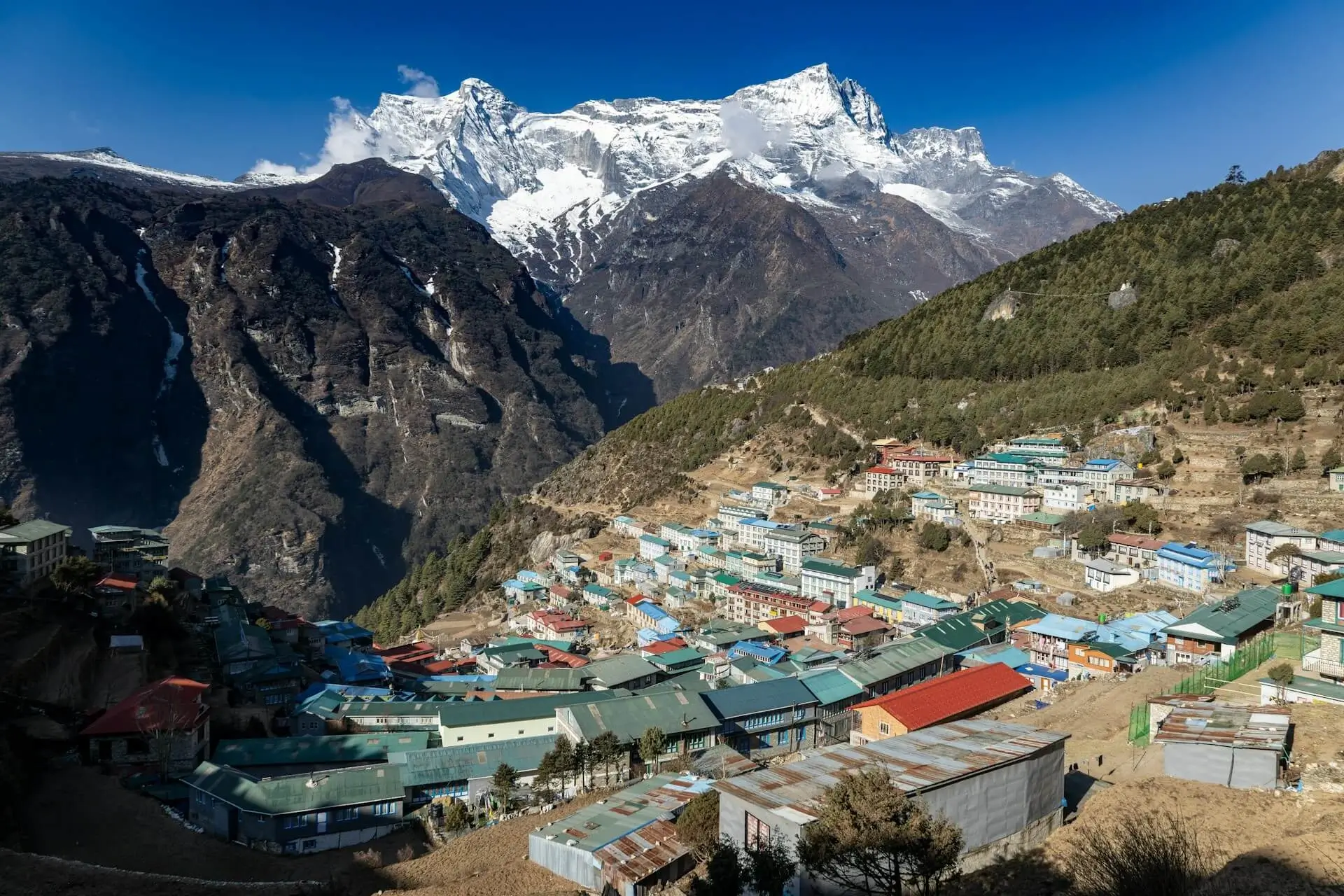
Namche Bazaar sits in Khumbu Pasanglhamu Rural Municipality, in Koshi Province, roughly 138 kilometres northeast of Kathmandu in a straight line. It’s built into a natural amphitheatre-shaped bowl on the mountainside, which gives the town its distinctive horseshoe layout when viewed from above or from the trail approaching it.
Namche is widely known as the administrative and trading headquarters of the entire Khumbu region, and the ward it’s located in has a population of 1,255 people according to the most recent detailed census, spread across a few hundred households. Namche by itself has almost half of the population of the ward. Despite this modest size, it functions as the single most developed settlement in the upper Khumbu, with facilities you won’t find anywhere else at this altitude.
Namche Bazaar Elevation
Namche Bazaar sits at an elevation of 3,440 metres, or 11,286 feet, above sea level. This makes it one of the first genuinely high-altitude stops on the Everest Base Camp trekking route, and it’s the point where altitude starts to become a real factor for most trekkers, even those in strong physical condition.
At this height, oxygen availability drops to roughly two-thirds of what it is at sea level, which is enough to trigger noticeable physiological effects even before trekkers reach anywhere close to Base Camp itself. This is a big part of why Namche plays such a central role in how Everest region itineraries are structured.
Lukla to Namche Bazaar Distance and Trek
Getting to Namche Bazaar starts with a flight into Lukla, followed by a trek that most itineraries spread across two days.
Lukla to Namche Bazaar distance: The trail covers approximately 13 to 15 kilometres, though this varies somewhat depending on the exact route measured.
Despite the relatively short distance, it involves a significant elevation gain, climbing from Lukla’s 2,860 metres up to Namche’s 3,440 metres, a net gain of roughly 600 metres across a route that includes both ascents and descents along the way.
The typical two-day breakdown:
- Day one: Lukla to Phakding. This is a relatively easy 3 to 4 hour walk, mostly downhill or flat, giving trekkers an easier first day to adjust before the harder climb ahead.
- Day two: Phakding to Namche Bazaar. This is the tougher of the two days, involving a steep, sustained climb through pine forest, several suspension bridge crossings, and entry into Sagarmatha National Park before finally reaching Namche. This day typically takes 6 to 8 hours of walking.
The steepest and most demanding section of the entire route is generally the final climb from Jorsalle up to Namche, which takes roughly 2 to 3 hours on its own and offers trekkers their first real glimpse of Everest on a clear day, a moment that tends to make the tough climb feel worthwhile.
Because of the altitude gain involved, attempting this route in a single day from Lukla isn’t recommended, even though it’s technically possible distance-wise. Taking two days with an overnight in Phakding gives the body a much safer, steadier adjustment to the altitude.
Namche Bazaar Weather and What to Expect
Namche Bazaar’s weather follows a fairly consistent mountain pattern, though it does shift meaningfully across the seasons.
- Average annual temperature sits around 6.1°C, reflecting the town’s high-altitude, cold-dry-winter climate classification.
- Spring (March to May) brings daytime temperatures around 10 to 15°C, alongside blooming rhododendrons across the surrounding hillsides, making this one of the most popular times to visit.
- Autumn (September to November) offers similarly stable, clear conditions, considered alongside spring as the best trekking season for reliable weather and mountain visibility.
- Monsoon season (June to August) brings frequent rainfall and misty conditions, making trekking considerably less comfortable and views far less reliable during this window.
- Winter is cold and dry, with clear skies but significantly colder temperatures, particularly overnight.
A defining feature of Namche Bazaar temperature patterns is how much it shifts within a single day. Mornings tend to be clear and cold, midday sun can feel surprisingly strong given the altitude, and temperatures drop rapidly again once the sun goes down.
Nighttime temperatures in guesthouses, which are rarely heated, often approach freezing even outside the coldest winter months, so packing proper layers matters regardless of which season you’re trekking in.
Why Namche Bazaar Matters So Much to the Region
Namche’s significance goes well beyond being a convenient stopover on the way to Everest Base Camp.
- It’s the primary trading hub for the Khumbu region. Long before organized trekking existed, Namche served as a trading point between Tibet and the lower Khumbu valley, and that trading identity still shapes the town today, most visibly through its famous Saturday market.
- It’s the region’s acclimatization checkpoint. Most Everest region itineraries include two nights in Namche specifically for altitude adjustment, making it a physiological milestone as much as a geographic one. Mild altitude symptoms- headaches, poor sleep, a faster resting heart rate- affect a significant share of trekkers here, which is exactly why the extra night matters.
- It has real infrastructure other Khumbu villages don’t. Namche is home to the Sagarmatha National Park Visitor Centre, a Sherpa culture museum, an ATM, internet cafes, bakeries, and gear shops, giving trekkers a level of comfort and resupply options that thins out considerably at higher elevations.
- It anchors the wider trekking network. Routes toward Gokyo, the Everest Base Camp trail, and the Renjo La and Cho La pass circuits all pass through or near Namche, making it the functional hub the entire upper Khumbu trekking network is built around.
Local Insight: Namche as the Real Gateway to Everest
Guides who’ve spent years walking this route consistently point to Namche as the moment a trek genuinely starts to feel like the Himalayas, more than Lukla, and more than the villages along the way. It’s the first place where the scale of the mountains fully reveals itself, where Sherpa culture is visibly woven into daily life rather than glimpsed in passing, and where trekkers get their first real sense of how remote, self-sufficient, and resilient this region’s communities are.
For many first-time trekkers, an acclimatization day in Namche also becomes an unplanned highlight of the trip. A short hike up toward the old Syangboche airstrip or the Everest View Hotel, both well above the town itself, offers some of the clearest early views of Everest available anywhere on the standard route, all while serving the practical purpose of aiding acclimatization through gradual, controlled altitude exposure.
Begin Your Everest Journey Through Namche Bazaar
Every one of our Everest region treks passes directly through Namche Bazaar, making it a central stop on each of these routes:
- Everest Base Camp and Island Peak, 19 days, combining the classic Base Camp trek with a climb up Island Peak, a popular first 6,000 metre summit.
- Kala Pattar and Everest Base Camp, 15 days, the classic route to Base Camp with the added summit of Kala Patthar for the closest possible view of Everest without technical climbing.
- Lower Everest Region Trek, 9 days, a shorter option for trekkers with less time who still want to experience Namche, Sherpa villages, and views of Everest and its neighboring peaks.
Ready to experience Namche Bazaar and the Everest region for yourself? Reach out to our team to book your Everest region trek with Glacier Safari Treks.
FAQs
1. What is the elevation of Namche Bazaar?
Namche Bazaar sits at 3,440 metres, or 11,286 feet, above sea level.
2. How far is Lukla to Namche Bazaar, and how long does it take?
The distance is approximately 13 to 15 kilometres, typically covered over two days, with an overnight stop in Phakding along the way.
3. What is the weather like in Namche Bazaar?
Namche has an average annual temperature of around 6.1°C, with milder daytime temperatures of 10 to 15°C during spring and autumn, colder dry conditions in winter, and misty, rainy conditions during the summer monsoon season.
4. Why do trekkers spend two nights in Namche Bazaar?
Namche is the first major high-altitude stop on the Everest Base Camp route, and the extra night allows the body to acclimatize properly before continuing to higher elevations, reducing the risk of altitude sickness later in the trek.
5. Is Namche Bazaar just a stop on the way to Everest Base Camp, or worth visiting on its own?
It’s genuinely worth experiencing in its own right. Namche offers real cultural and historical significance as the Khumbu region’s main trading hub, along with infrastructure, views, and a Saturday market unlike anywhere else on the route.