

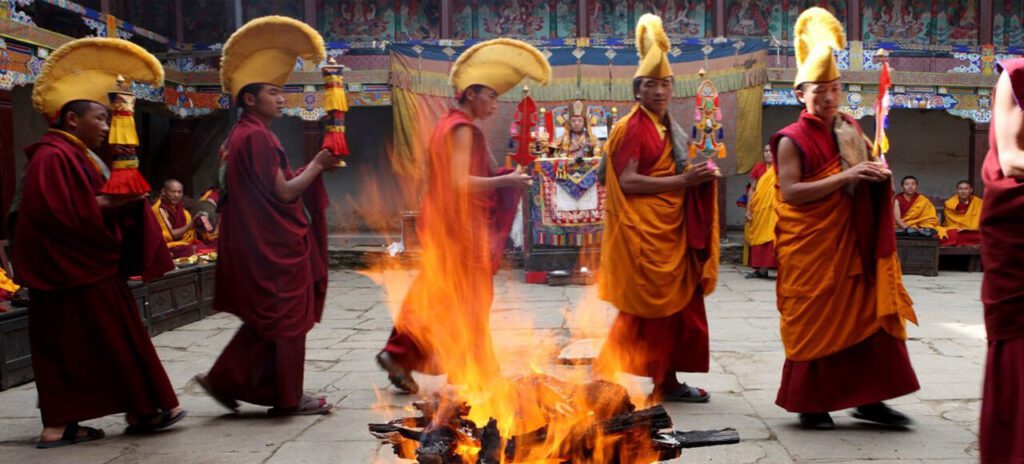
The Sherpa people practice Mahayana Buddhism, specifically the Nyingmapa sect, often referred to as the Red Hats. Their spiritual life blends ancient traditions with formal liturgical ceremonies. These practices guide daily life from farming cycles to the journey of the soul after death.
Religion is not separate from life for the Sherpas. It shapes work, festivals, family roles, and how death itself is understood.
The Role of Tormas in Rituals
No Sherpa ceremony takes place without tormas.
Tormas are sacrificial cakes made from dough and butter. They symbolize gods and spirits and serve as offerings to deities during both public and private rituals. Only a lama holds the knowledge and skill required to prepare them.
The shape of each torma depends on the specific liturgical text being recited. Once the ritual ends, participants eat the dough portion, while the butter—often mixed with dyes—is discarded.
Ritual Altar Items
For major ceremonies, the altar includes more than tormas. It typically features:
- Three chalices carved from human skulls, filled with tea as a substitute for beer and blood
- Clean drinking water and water for washing feet
- Flowers and incense
- A ritual lamp and traditional cymbals
- Five symbolic objects representing the senses:
- A mirror
- A musical instrument
- Incense
- Food
- A piece of fabric
Lama’s Ritual Tools
The lama also uses specialized ritual objects, including:
- A dorje and a bell
- A miniature chorten
- A sacred book
- A metal mirror
- Various cymbals
- A conch shell
- A trumpet made from a human femur
Each item serves a precise role within the liturgy. Despite the sacred setting, ceremonies are not always solemn. Breaks allow for conversation, laughter, and casual interaction among attendees.
Our Upcoming Trek: Solu Sherpa Village Trek
Seasonal Ceremonies and Festivals
Sherpa religious life follows the agricultural calendar closely. Major rituals mark planting, harvests, and the movement of livestock.
Tsirim and Osho
- Tsirim takes place at the beginning and end of the farming season. It involves conjuring and expelling evil spirits.
- Two organizers, known as lawas, collect grain to provide food and drink for ritual officials.
- Osho focuses on protecting arable land from harm.
Niungnes and Dumje
- Niungnes lasts three days in late May or early June and centers on the forgiveness of sins.
- One month later, the community celebrates Dumje, the great festival of the gompa (monastery).
Dumje occurs after potato planting and weeding are complete, while cattle graze in high pastures. The entire community shares the cost of food and drink.
During Dumje, Sherpas wear new clothing:
- Men wear the chuba, a robe-mantau that leaves the right shoulder bare
- Women wear the ingi robe covered with a mati apron
They display their finest jewelry, including turquoise chains, coral beads, and decorated fetish boxes.
Yer-chang and Mani-rindu
- Yer-chang is a summer festival calling for protection of cattle in the high pastures. Families celebrate for as many days as there are households present.
- Mani-rindu takes place at the Tangboche Monastery and features ritual dances.
These dances symbolize:
- The victory of Gelugpa Buddhism over other forms
- The victory of Buddhism over the Bön religion
- The triumph of good over evil
- The defeat of malevolent spirits
Mortuary Rites and the Journey of the Soul
When a Sherpa dies, the family immediately calls a lama. Using astrology, the lama determines:
- Whether the body should be cremated, buried, or placed in a torrent
- Who is permitted to touch or handle the body
The body is tied in a sitting position and wrapped in white cloth, then enclosed in a wooden frame. A paper bearing astrological signs is placed on top to ward off evil spirits.
The lama prepares specific tormas on the altar and recites sacred texts to guide the deceased. Cymbals, drums, and trumpets accompany the ritual, while relatives bring beer and spirits.
Funeral Practices by Status
- Children are buried
- The very poor may be placed in torrents if they cannot afford funeral rites
- Cremation excludes women from the site
A small procession carries the body to a high point near the village. During cremation, the lama advises the spirit, or sem, to forget earthly attachments and focus on the path to Decachen.
The 49-Day Transition
The journey of the sem to Decachen lasts 49 days. During this period:
- The living perform shetu prayers to assist the soul
- Food and money, known as gyewa, are distributed in the deceased’s name
After the funeral, a fragment of bone is recovered from the pyre. On the fiftieth day, the bone is crushed and mixed with clay to form a miniature chorten.
This chorten is placed near the prayer wheel of the gompa. The final act involves the head of the mourning party informing the lama of the funeral expenses. The lama symbolically entrusts this amount to the deceased.
Prayer Wheels
Prayer wheels are central to Sherpa religious practice.
These metal cylinders contain rolls of printed prayers or mantras. When spun, the prayers are believed to unfold and travel spiritually into the world. Turning a prayer wheel earns merit—not only for the individual, but for the entire community.