

Table of Contents
For nearly every trekker heading toward Everest Base Camp, the journey doesn’t really begin on the trail. It begins the moment the plane touches down on a short, sloped runway carved into a mountainside at Lukla. This is Tenzing-Hillary Airport, and it’s often the first taste trekkers get of just how dramatic the Khumbu region really is.
Here’s a detailed look at Lukla Airport, why it matters so much to the region it serves, and what the current situation looks like for anyone planning to fly there.
Quick Summary: Lukla Airport in Nepal
- Tenzing-Hillary Airport (Lukla Airport) is the main gateway to the Everest region and Everest Base Camp treks.
- Located at 2,846 meters (9,337 ft) in Solukhumbu District, Nepal.
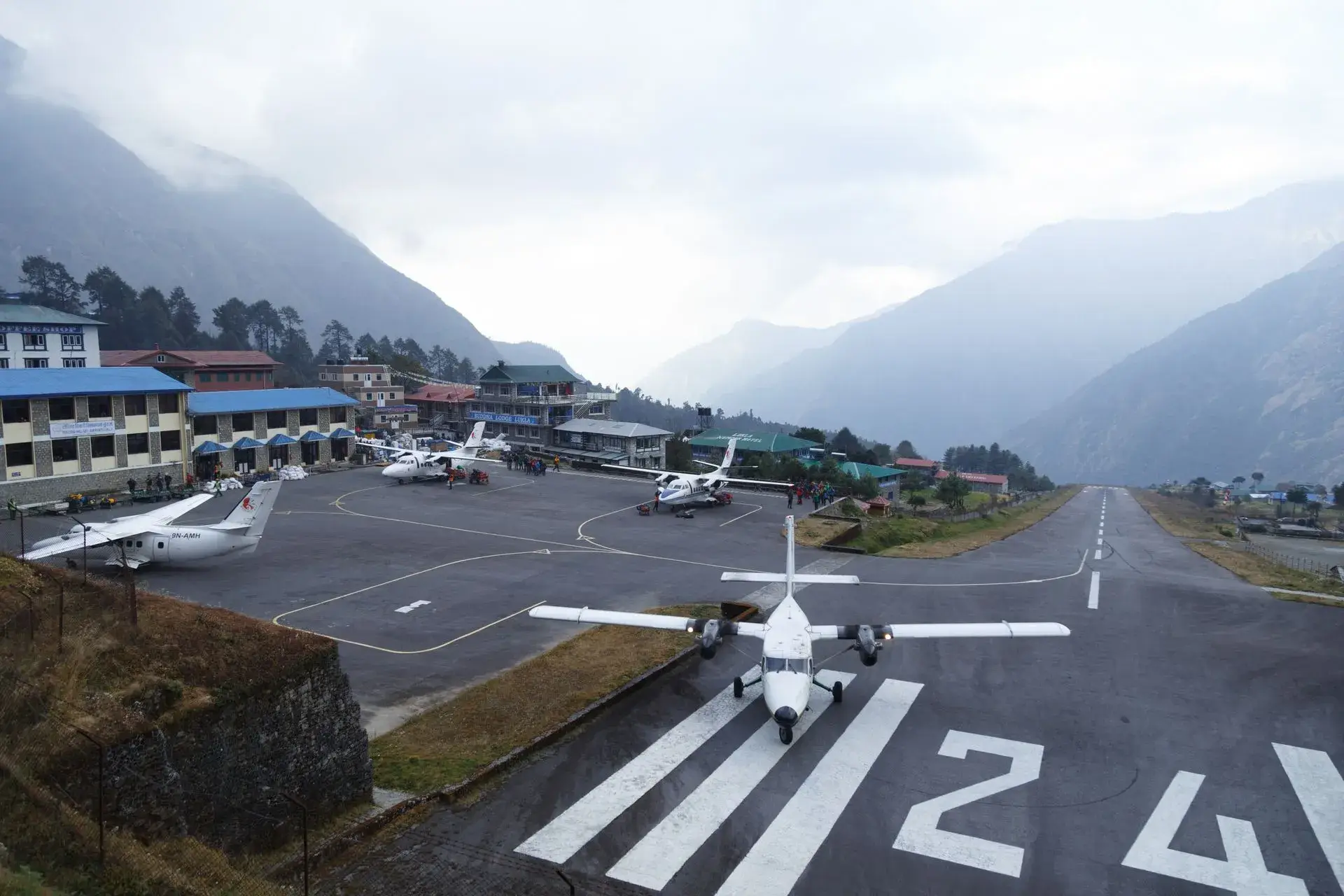
- Features a 527-meter sloped runway, making it one of the world’s most challenging commercial airports.
- Flights are highly weather-dependent, with delays common due to cloud cover and mountain winds.
- During peak trekking seasons, most flights operate via Ramechhap (Manthali Airport) instead of Kathmandu.
- The airport is essential for tourism, local supplies, emergency evacuations, and the economy of the Khumbu region.
- Most Everest trekking itineraries include buffer days to accommodate potential flight delays.
Where Is Lukla Airport Located?
Lukla Airport, officially named Tenzing-Hillary Airport, sits in Khumbu Pasang Lhamu Rural Municipality, Solukhumbu District, in Nepal’s Koshi Province. It’s located roughly 138 kilometres northeast of Kathmandu by air, in the small mountain town of Lukla, which serves as the southern gateway into the Khumbu Valley and the broader Everest region.
The airport lies at the edge of the Sagarmatha National Park buffer zone. There are no roads connecting Lukla to Kathmandu or any other major town, which makes this airport, and the trail network it feeds into, the primary way in and out of the entire upper Khumbu region.
Lukla Airport’s Elevation and Runway
Tenzing-Hillary Airport sits at an elevation of approximately 2,846 metres, or 9,337 feet, above sea level, placing it among the higher-altitude commercial airports anywhere in the world. Trekkers stepping off the plane are already at a meaningful elevation before they’ve taken a single step on the trail, which is part of why altitude planning for the Everest region trek begins from the moment you land, not from Namche Bazaar as some assume.
The runway itself is one of the most distinctive features of the airport:
- The runway is only 527 metres long and 20 metres wide, among the shortest runways used for commercial aircraft anywhere in the world.
- It’s inclined at roughly 12 degrees, sloping upward from south to north, which helps slow aircraft on landing and assists with lift on takeoff, given the thin air at this elevation.
- Mountains surround the airport on multiple sides, with a steep valley drop at one end of the runway and a rock wall at the other, leaving no margin for error during approach or departure.
- Flights operate under strict visual flight rules. Because of the surrounding terrain, pilots need clear visibility to land or take off, which is the main reason flights are scheduled for early morning, before cloud cover and wind typically build later in the day.
Why the Airport Was Built, and Why It Was Renamed
Before Lukla Airport existed, reaching the Khumbu region meant a multi-day trek from Jiri or other lower access points, a journey that could take the better part of a week before a visitor even reached what is now the standard trailhead. The airport began construction in 1964 with strong involvement from the local community, and operations formally began in September 1971.
In 2008, the airport was officially renamed Tenzing-Hillary Airport, honoring Tenzing Norgay and Sir Edmund Hillary, the first two climbers confirmed to summit Everest in 1953. The name reflects a shared legacy between Sherpa mountaineering knowledge and international collaboration, a partnership that continues to define how the Everest region operates today.
Why This Airport Matters So Much to the Region
Lukla Airport isn’t just a convenience for trekkers. It’s the backbone of how the entire Khumbu region functions.
- It’s the primary supply line for the region. With no roads reaching Lukla or the villages beyond it, nearly everything, from building materials to food supplies to medical equipment, moves through this airport before continuing on foot or by yak train further into the valley.
- It supports the local economy directly. Teahouses, lodges, guiding services, and portering work throughout the Khumbu region depend on a steady flow of trekkers who arrive through Lukla, making the airport a critical piece of economic infrastructure for Sherpa communities.
- It cut travel time into the region dramatically. What was once a week or more of trekking from Jiri became a 30-40 minute flight, opening the region to a volume of visitors that would have been unimaginable under the old overland route.
- It enables emergency evacuation. For trekkers who develop altitude sickness or injuries deep in the Khumbu Valley, Lukla and its helicopter operations are often the fastest route to proper medical care.
Without this airport, the Everest Base Camp trek as most people know it today, a two-week journey rather than a month-long overland expedition, simply wouldn’t exist in its current form.
Weather and Why Flights Get Delayed
Weather is the single biggest variable affecting any Lukla flight, and understanding why helps set realistic expectations before you travel.
- Wind patterns shift through the day. Mornings typically bring calmer northeast winds, while a southwest wind tends to build by mid to late morning as the sun heats the surrounding mountains, which is why flights are scheduled as early as possible.
- Cloud cover builds quickly at altitude. Because flights operate under visual rules, any drop in visibility can ground flights until conditions clear, sometimes for hours, occasionally for a full day or more.
- Monsoon and winter months see the most disruption. Heavy cloud cover during the monsoon season and cold, unpredictable conditions in winter both increase the likelihood of delays compared to the more stable spring and autumn trekking seasons.
- Delays are common but rarely trip-ending. Most trekking itineraries build in buffer days specifically to absorb Lukla flight delays without derailing the overall schedule.
The Current Situation: Ramechhap Diversions
One of the most important recent developments for anyone planning a Lukla flight is the seasonal diversion to Ramechhap. During peak trekking months, spring from mid-March through mid-May and autumn from late September through November, most Lukla flights now depart from Manthali Airport in Ramechhap District rather than Kathmandu.
Here’s what that means in practice:
- A 4-5 hour drive from Kathmandu to Ramechhap is required before catching the flight, with most departures leaving Kathmandu in the very early morning, often around 1 or 2 a.m.
- The flight itself is shorter from Ramechhap, taking roughly 15 to 20 minutes compared to 30 to 35 minutes from Kathmandu, since Ramechhap sits closer to Lukla.
- Reliability is actually better via Ramechhap. Sitting at a much lower elevation with no international air traffic competing for runway space, Ramechhap offers a wider, cleaner weather window, allowing airlines to complete more flight rotations once conditions clear.
- Outside peak season, flights typically operate directly from Kathmandu, so the Ramechhap diversion mainly affects trekkers traveling during the busiest spring and autumn windows.
This shift was introduced by Nepal’s Civil Aviation Authority to ease congestion and improve overall flight reliability during the busiest months, and it’s now a standard part of planning an Everest region trek during peak season.
Local Insight: Lukla as the Gateway to Everest
For anyone who has trekked in this region, Lukla represents more than an airport. It’s the transition point between ordinary travel and genuine mountain adventure. Guides who spend season after season flying in and out of Lukla often describe a familiar rhythm to the whole experience: the early wake-up call, the short, dramatic flight, and that first view of the surrounding peaks as the plane banks toward the runway.
For trekkers, the flight itself often becomes one of the most memorable parts of the entire trip, a reminder that they’ve truly left the ordinary world behind well before their boots even touch the trail.
Start Your Everest Adventure with Confidence
Nearly every trek into the Everest region with Glacier Safari Treks has trips ending at Lukla. Here are the treks currently on offer:
- Everest Base Camp and Island Peak, 19 days, combining the classic Base Camp trek with a climb up Island Peak, a popular first 6,000 metre summit.
- Kala Pattar and Everest Base Camp, 15 days, the classic route to Base Camp with the added summit of Kala Patthar for an even closer view of Everest.
- Lower Everest Region Trek, 9 days, a shorter option for trekkers with less time who still want to experience Sherpa villages and views of Everest and its neighboring peaks.
Ready to experience the flights of Lukla for yourself? Reach out to our team to book your Everest region trek with Glacier Safari Treks.
FAQs
1. Why is Lukla Airport considered one of the most extreme airports in the world?
The combination of its high elevation, short sloped runway, surrounding mountainous terrain, and reliance on strict visual flight rules makes every landing and takeoff technically demanding, even for highly experienced pilots.
2. Do all Lukla flights depart from Kathmandu?
Not during peak season. From mid-March to mid-May and late September through November, most flights operate from Ramechhap District instead, due to seasonal diversions introduced by Nepal’s Civil Aviation Authority.
3. How long is the flight to Lukla?
From Kathmandu, the flight takes roughly 30 to 35 minutes. From Ramechhap during peak season diversions, it’s shorter, typically 15 to 20 minutes.
4. What happens if my Lukla flight gets delayed?
Delays are common, particularly during monsoon and winter months, but most trekking itineraries include buffer days specifically to absorb these delays without affecting your overall schedule.
5. Why was the airport renamed Tenzing-Hillary Airport?
It was renamed in 2008 to honor Tenzing Norgay and Sir Edmund Hillary, the first two climbers confirmed to summit Mount Everest in 1953.