

Table of Contents
Short answer: choose the Gokyo Lakes Trek if you want turquoise glacial lakes, a panoramic summit view from Gokyo Ri and less of the main Khumbu trail. Choose the Classic Everest Base Camp Trek if standing at Everest Base Camp and climbing Kala Patthar is the point of the trip. Both are 14-day packages from €1,734, and both are demanding high-altitude treks.
The Everest region has some of the world’s best trekking: Sherpa villages, monasteries, glaciers, high passes and views of the highest mountains on Earth. The area is protected as Sagarmatha National Park, a UNESCO World Heritage site since 1979, and UNESCO notes that the Sherpa people and their culture add to its value.
The two routes share the first three days to Namche Bazaar and the final descent, then split into different valleys. This guide compares them on scenery, difficulty, sleeping altitude, itinerary, season, permits and cost, using the current Glacier Safari Treks itineraries.
Package details were checked on the Glacier Safari Treks website on 20 November 2026.
Gokyo Lakes vs Everest Base Camp: quick comparison
| Category | Gokyo Lakes Trek | Classic Everest Base Camp |
|---|---|---|
| Duration | 14 days | 14 days |
| Trek start | Lukla (Day 1 is the transfer to Ramechhap, then a flight to Lukla) | Lukla (same) |
| Highest point | Gokyo Ri, about 5,350 m | Kala Patthar, about 5,550 m |
| Highest night | Gokyo, 4,750 m | Gorak Shep, 5,140 m |
| Reaches Everest Base Camp | No | Yes (listed at about 5,300 m) |
| Main highlight | Gokyo Lakes, Gokyo Ri, Ngozumpa Glacier | Everest Base Camp, Kala Patthar, Tengboche |
| Everest view | Wide panorama from Gokyo Ri | Close-up from Kala Patthar |
| Difficulty | Challenging | Medium on the package page, but high-altitude |
| Best seasons | Spring and autumn | Spring and autumn |
| Accommodation | Mountain lodges | Mountain lodges |
| Starting price | From €1,734, with domestic flights | From €1,734, with domestic flights |
| Trail character | Quieter in sections | The main Khumbu route |
What is the Gokyo Lakes Trek like?
The Gokyo Lakes Trek is the better fit if you want the quieter side of the Everest region. Instead of continuing up the main valley to Everest Base Camp, it turns north-west from Namche Bazaar into the Gokyo Valley.
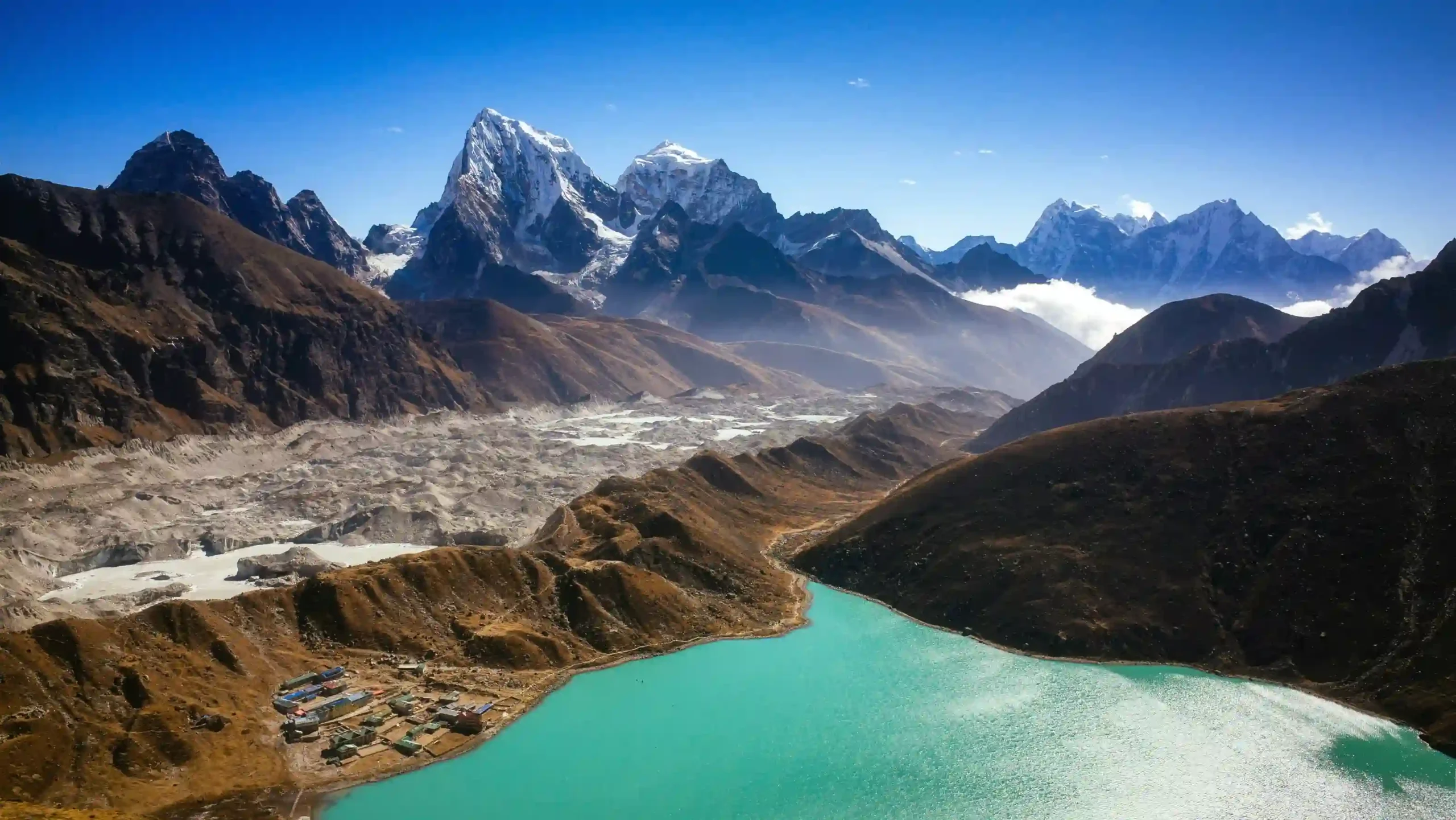
The main attraction is a chain of glacial lakes beneath rocky peaks. The Gokyo lakes are a Ramsar wetland of international importance, designated in 2007, at about 4,710-4,950 m near the headwaters of the Dudh Koshi River. Their turquoise water contrasts with the rock and snow around them.
On the Glacier Safari Treks itinerary you walk through Phakding, Namche Bazaar, Khumjung, Phortse Tenga and Luza before reaching Gokyo; the trail passes Machhermo on the way. The climb to Gokyo Ri, at about 5,350 m, gives a panorama of Everest, Lhotse, Nuptse, Makalu and Cho Oyu. The route also runs beside the Ngozumpa Glacier, which Nepal’s Department of National Parks and Wildlife Conservation lists as one of the park’s major glaciers, and its rocky moraine shows the glacial landscape up close.
What makes the Gokyo Lakes Trek special?
- The Gokyo Lakes: clear turquoise water below mountain walls, among the most scenic places in the Khumbu region.
- Gokyo Ri: one of the best panoramic viewpoints in the region, with several 8,000 m peaks in view.
- Ngozumpa Glacier: a different, rockier landscape from the main EBC valley.
- Quieter trails: parts of the Gokyo trail see fewer trekkers than the main Everest Base Camp route.
- Sherpa culture: the route still passes Sherpa villages, monasteries and mountain settlements.
It suits travellers who prefer natural landscapes and a less crowded part of the Everest region. See the Everest via Gokyo Lakes, 14 days package. It comes in service levels: Eco, where you trek without a porter, and Grand Comfort, with upgraded accommodation.
What is the Classic Everest Base Camp Trek like?
The Classic Everest Base Camp Trek is one of Nepal’s best-known treks. It follows the main Khumbu valley through Sherpa villages, suspension bridges, forests, monasteries and high settlements to the foot of the world’s highest mountain, 8,848 m according to UNESCO.
The Glacier Safari Treks itinerary flies to Lukla, then walks via Phakding and Namche Bazaar. It continues through Khumjung, Phortse, Pangboche, Dingboche and Lobuche to Everest Base Camp and Gorak Shep. Base camp is listed at about 5,300 m. Kala Patthar, at about 5,550 m, is the classic early-morning viewpoint for Everest and its neighbours. On the way you pass Tengboche Monastery, one of the most important Buddhist monasteries in the Khumbu region.
What makes the Classic Everest Base Camp Trek special?
- Everest Base Camp: the goal for many trekkers, and a base for mountaineering expeditions.
- Kala Patthar: a close view of Everest, best on a clear early morning.
- Tengboche Monastery: an introduction to Buddhist traditions and Sherpa culture.
- Namche Bazaar: a lively Sherpa town with shops, lodges, cafes and mountain views.
- Classic Himalayan scenery: forest, river valley, alpine terrain and rocky high mountain landscape.
If Everest Base Camp has always been on your list, this is the natural choice. See the Everest Base Camp Trek, 14 days package, plus our guides to how difficult the trek is and trekking it in autumn.
Which trek has better mountain views?
Both routes have spectacular scenery, but the views are different.
From Gokyo Ri you get a wide panorama of Everest, Lhotse, Makalu and Cho Oyu, with the lakes and the Ngozumpa Glacier spread out below. On the classic route you walk closer to the big peaks: Ama Dablam, Nuptse, Lhotse and Everest all frame the trail, and Kala Patthar gives the closest view of Everest on either itinerary.
If you want panoramas with glacial lakes, choose Gokyo. If you want the iconic Everest landscape and a close view from Kala Patthar, choose the classic route. Neither is objectively better; it depends on the scenery you want.
Which trek is harder: Gokyo Lakes or Everest Base Camp?
Both need good fitness. Expect several hours of walking a day, often 6–8 hours on the Gokyo route, on rocky trails and steep sections, while gaining altitude.
Glacier Safari Treks rates the Gokyo Lakes Trek as challenging: several days of uphill walking to higher settlements, then the climb to Gokyo Ri at about 5,350 m. The Everest Base Camp package is rated medium, but that is not an easy walk. It sleeps higher, at Gorak Shep (5,140 m, about 390 m above Gokyo), and Kala Patthar at about 5,550 m is demanding.
Altitude is the main risk on both. The US CDC Yellow Book quotes Wilderness Medical Society guidance: above 3,000 m, increase your sleeping altitude by no more than about 500 m a night, and allow an extra night for every 1,000 m of sleeping altitude gained. It describes headache as the main symptom of acute mountain sickness, usually with loss of appetite, dizziness, fatigue or nausea. The advice is never to go higher to sleep while you have symptoms, and to descend if they get worse.
- Train with regular walking, uphill sessions and cardio before you leave. See how to train for high-altitude treks and how to plan acclimatisation.
- Do not rush the ascent, and tell your guide early about headaches, nausea, dizziness or unusual tiredness.
- Ask a travel-medicine doctor before you travel whether altitude medication is right for you; the CDC page covers the options.
Gokyo Lakes vs Everest Base Camp: itinerary and sleeping altitude
Both packages run 14 days from Kathmandu and share Days 1 to 4. The sleeping altitude on each night is the figure that shows how the routes differ.
| Day | Gokyo Lakes Trek | Night (m) | Classic Everest Base Camp | Night (m) |
|---|---|---|---|---|
| 1 | Kathmandu to Ramechhap | n/a | Kathmandu to Ramechhap | n/a |
| 2 | Flight to Lukla, trek to Phakding | 2,610 | Flight to Lukla, trek to Phakding | 2,610 |
| 3 | Phakding to Namche Bazaar | 3,440 | Phakding to Namche Bazaar | 3,440 |
| 4 | Acclimatisation trek to Khumjung | 3,760 | Acclimatisation trek to Khumjung | 3,760 |
| 5 | Khumjung to Phortse Tenga | 3,675 | Khumjung to Phortse | 3,810 |
| 6 | Phortse Tenga to Luza | 4,390 | Phortse to Pangboche | 3,985 |
| 7 | Luza to Gokyo | 4,750 | Pangboche to Dingboche | 4,410 |
| 8 | Gokyo Ri, then to Na | 4,440 | Dingboche to Lobuche | 4,925 |
| 9 | Na to Phortse Tenga | 3,675 | Lobuche to Everest Base Camp, then Gorak Shep | 5,140 |
| 10 | Phortse to Pangboche | 3,985 | Kala Patthar, then down to Pheriche | 4,270 |
| 11 | Pangboche to Tengboche | 3,860 | Pheriche to Tengboche | 3,860 |
| 12 | Tengboche to Namche Bazaar | 3,440 | Tengboche to Namche Bazaar and Monjo | 2,835 |
| 13 | Namche Bazaar to Lukla | 2,840 | Monjo to Lukla | 2,840 |
| 14 | Lukla to Ramechhap, drive to Kathmandu | n/a | Lukla back to Kathmandu | n/a |
The main difference is the middle of the trip. The Gokyo route turns towards the lakes and Gokyo Ri, then returns through Phortse and Pangboche. The classic route continues up the main valley to Everest Base Camp and Kala Patthar. Flights and weather can change plans, so confirm the latest itinerary with Glacier Safari Treks before booking.
What is the best time to trek to Gokyo or Everest Base Camp?
Glacier Safari Treks lists spring and autumn as the best seasons for both treks. Compare all months in our best time to trek in Nepal guide.
- Spring (March to May): more comfortable temperatures, clearer days, rhododendron forests in bloom at lower elevations and good mountain views in favourable weather.
- Autumn (September to November): the monsoon has usually passed, so skies are clearer and visibility is good. Trails are popular. See what to pack for an autumn trek.
- Winter (December to February): colder, with snowfall and harder conditions at altitude. Some lodges and trail sections may have limited services.
- Monsoon (June to August): heavy rain, cloud and possible disruption. Flights to Lukla can be affected by poor visibility, and trails can be slippery.
Flights to Lukla may be rerouted through Ramechhap in spring and autumn, which is why both packages begin with a transfer there.
What permits and insurance do you need?
Glacier Safari Treks handles the paperwork, but you should know what is required.
- Permits: both treks are inside Sagarmatha National Park. Park permits are issued through the Nepal Tourism Board in Kathmandu or at the park entrance gate at Monjo, according to the park’s official brochure. Our Gokyo package page also lists the Khumbu Pasang Lhamu Rural Municipality entrance permit. Both packages include national-park entry fees and TIMS registration.
- Insurance: Glacier Safari Treks requires valid trekking insurance with helicopter evacuation cover of at least EUR 15,000 and explicit cover for altitude sickness. The policy must reach your route’s highest point: at least 5,545 m for Everest Base Camp with Kala Patthar. For Gokyo Ri, cover to at least 5,350 m. Read the trekking insurance requirements before you buy.
- Visa and documents: see our Nepal visa and permits page.
How much do the Gokyo Lakes and Everest Base Camp treks cost?
Both 14-day packages are listed from €1,734, including domestic flights. Final cost depends on service level and extras. For a full breakdown, see the cost to trek Everest Base Camp.
Included:
- English-speaking trekking guide
- One porter for every two trekkers (Eco level on the Gokyo package trekks without a porter)
- Accommodation and meals during the trek (all meals except in Kathmandu)
- National park entry fees and TIMS registration
- Insurance for Nepali staff
- Ramechhap–Lukla return flights
- Private return transfers between Kathmandu and Ramechhap
Not included:
- Personal travel insurance with mountain rescue cover
- Nepal visa
- Personal expenses such as hot showers, tips and device charging
- Entry fees for cultural sites such as monasteries
- Hotel stay in Kathmandu (listed on the Gokyo package)
Can you do Gokyo Lakes and Everest Base Camp in one trek?
Yes, but not on the standard 14-day packages. A combined route needs more days and a high pass crossing, such as Renjo La or Cho La. Glacier Safari Treks offers Everest Base Camp with Renjo and Chola Passes and an Everest Base Camp via Chola Pass package. Our guides to Cho La and Renjo La and the Renjo Pass and Cho La trek explain the options.
So, which route should you choose?
Both treks are remarkable, and you cannot go far wrong. Choose by what you want to see.
Choose the Gokyo Lakes Trek if:
- You want to see the Gokyo Lakes.
- You enjoy glacial landscapes and panoramic views.
- You prefer quieter trails in parts of the Everest region.
- You want to climb Gokyo Ri.
- You want a different side of the Khumbu Valley.
Choose the Classic Everest Base Camp Trek if:
- Reaching Everest Base Camp is on your bucket list.
- You want to stand on Kala Patthar.
- You want the famous Everest trail.
- You are interested in the history and atmosphere of Everest mountaineering.
- You want to see Namche Bazaar and Tengboche Monastery.
Still unsure? Ask yourself which moment you would rather remember: standing beside a turquoise Gokyo lake, or reaching the base camp of the world’s highest mountain.
Plan your Everest region trek with Glacier Safari Treks
Choosing the route is one part of the plan. Glacier Safari Treks has organised treks in Nepal since 1986, and its guides are trained in mountain rescue and altitude-sickness management.
Explore the Everest via Gokyo Lakes and Everest Base Camp packages for current dates and prices, or contact the team or plan a tailor-made trip if you want a private departure.
Frequently asked questions
Is the Gokyo Lakes Trek harder than Everest Base Camp?
Glacier Safari Treks rates the Gokyo Lakes Trek as challenging and its Classic Everest Base Camp package as medium. Both involve high-altitude walking and need good fitness. Everest Base Camp sleeps higher (5,140 m at Gorak Shep, against 4,750 m at Gokyo).
Can you see Mount Everest from Gokyo Ri?
Yes. Gokyo Ri, at about 5,350 m, gives panoramic views of Everest, Lhotse, Nuptse, Makalu and Cho Oyu, and is a highlight of the Gokyo Lakes Trek.
Does the Gokyo Lakes Trek include Everest Base Camp?
No. The 14-day Gokyo itinerary visits the Gokyo Valley and Gokyo Ri but not Everest Base Camp. To see both, choose a longer combined route that crosses a high pass.
Which is quieter, Gokyo or Everest Base Camp?
Parts of the Gokyo trail see fewer trekkers than the main Everest Base Camp route, but the first days to Namche Bazaar are shared by both.
How high do you sleep on each trek?
The highest night on the Gokyo Lakes Trek is Gokyo at 4,750 m. On the Everest Base Camp Trek it is Gorak Shep at 5,140 m. The summit viewpoints are Gokyo Ri (about 5,350 m) and Kala Patthar (about 5,550 m).
How much do the Gokyo Lakes and Everest Base Camp treks cost?
Both 14-day packages are listed from €1,734 with domestic flights. Personal insurance, the Nepal visa, personal expenses and entry fees for cultural sites are not included. Confirm the latest price with Glacier Safari Treks.
What permits do I need for the Everest region?
Both treks are in Sagarmatha National Park and need a park entry permit; the Gokyo package page also lists the Khumbu Pasang Lhamu Rural Municipality permit. The packages include national-park fees and TIMS registration.
How many days are needed for Gokyo Lakes and Everest Base Camp?
Glacier Safari Treks offers separate 14-day packages for each. A combined route takes more days, depending on the itinerary and whether you cross a high pass.
What is the best time to trek to Gokyo Lakes or Everest Base Camp?
Spring (March to May) and autumn (September to November) are the best seasons for both routes, with more favourable weather and better mountain visibility.