

France sends more trekkers to Nepal per capita than almost any other European country. The trail culture resonates: the physical engagement, the mountain landscape, the self-sufficiency of moving through high terrain with everything you need on your back or carried by someone who knows the route better than you ever will. What French trekkers are occasionally less prepared for is the specific character of the tea house system that makes long-distance Himalayan trekking possible without tents, cooking equipment, or expedition logistics.
A tea house is not a hotel. It is not a refuge in the Alpine sense either, though the comparison is closer. Understanding what it is, how it operates, and what to expect from it changes the experience from a series of pleasant or unpleasant surprises into something you can engage with on its own terms.
What a Tea House Is
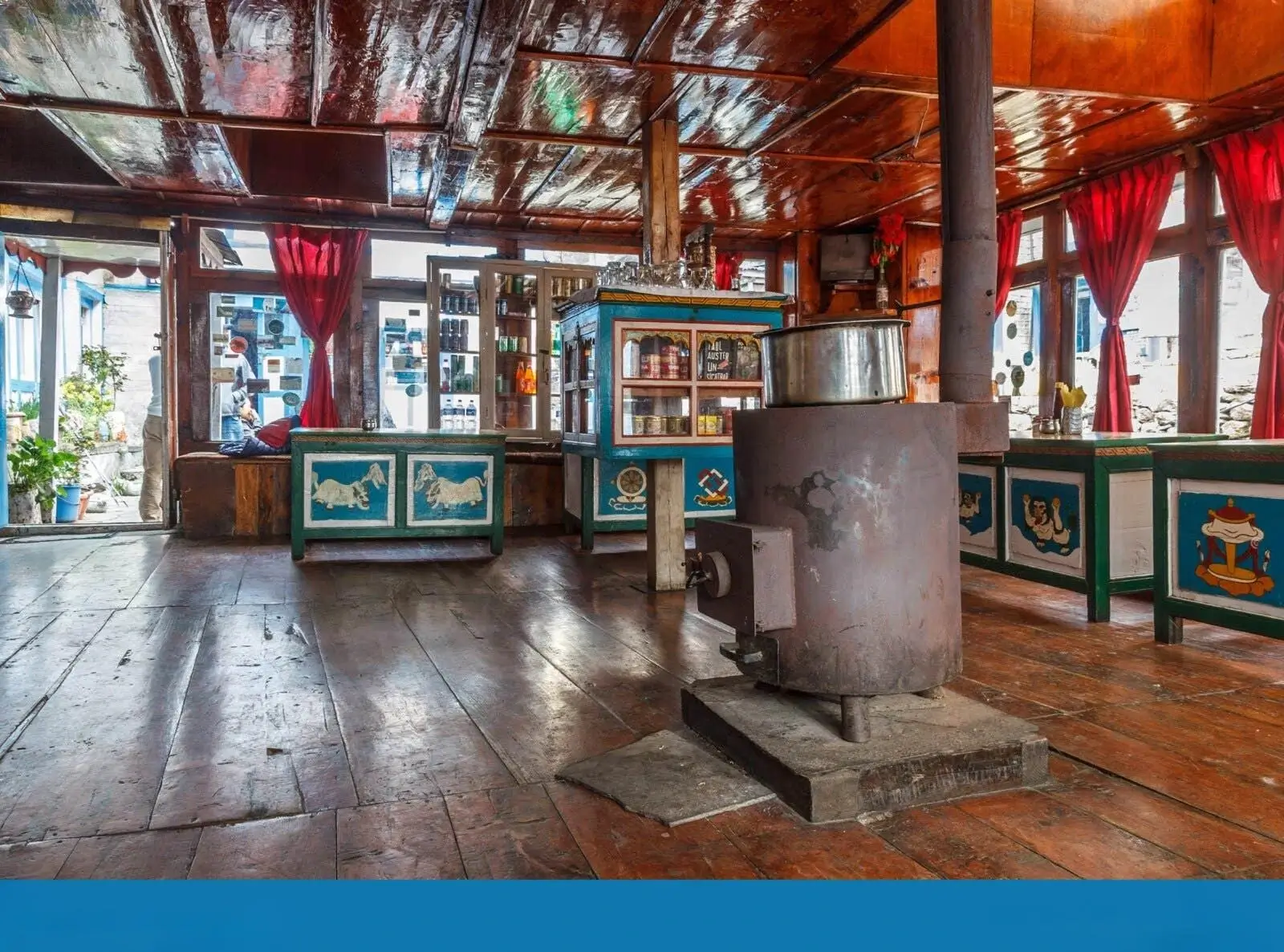
The Nepali word most commonly used is lodge, though tea house, guesthouse, all describe variations of the same thing: a family-run accommodation and dining establishment built along a trekking route to serve the passing trade of trekkers, porters, and local travelers.
The typical tea house structure involves:
- A ground-floor dining room that functions as the social centre of the building, where food is prepared, meals are served, and trekkers congregate in the evening
- Sleeping rooms on the upper floor or in an attached building, ranging from simple wooden partitioned rooms to more recently constructed stone rooms with insulation
- A kitchen operated by the family, usually behind a partition or in a separate room from the dining area
- Basic bathroom facilities, which range from an attached private bathroom in more developed lodges to a shared outdoor toilet on more remote routes
- A wood or yak-dung burning stove in the dining room that provides the primary heat source in the evening
The family who runs the tea house typically lives in the building or in an adjacent house. The children may help serve meals or carry supplies. The husband may work as a porter or guide during trekking season. The wife often manages the lodge operation directly. The business is a family enterprise in the most literal sense.
How the Business Model Works
Understanding the economics of a tea house explains several things about how they operate that might otherwise seem puzzling to a French traveler accustomed to clearly separated accommodation and dining costs.
The Room Price Model
On most established routes, the accommodation charge is deliberately kept low on the Annapurna Circuit or Everest Base Camp trail. This is not because the accommodation is worthless. It is because the business model is built around meals, not beds.
The unspoken arrangement is that if you sleep in a tea house, you eat there. The lodge owner has agreed to a low room rate on the understanding that three meals per trekker per day will pass through the kitchen.
This is important to understand before arriving with a bag full of provisions purchased in Kathmandu.
Food Pricing at Altitude
Food prices in tea houses increase with altitude for reasons that are straightforward once you know them. Everything that appears on the dining room table was carried there, either by porter, by pack animal, by helicopter for the highest lodges, or grown in the narrow plots of land the family maintains in the valley below.
A plate of dal bhat at Namche Bazaar costs more than the same plate in Lukla. The same plate at Gorak Shep costs considerably more than Namche. The price differential is not a tourist premium. It is the cost of logistics at altitude, and it is the same for every trekker regardless of nationality.
Cash Is the Only Currency
Tea houses on trekking routes above the major villages operate exclusively on cash. There are no card machines, and there is no Wise transfer. The trekker who arrives at a high-altitude lodge without Nepali rupees in their pocket has a problem.
The habit of travelling light on cash and relying on cards works in Kathmandu, Pokhara, and Namche Bazaar, where ATMs and card machines exist. It does not work above these points. Carrying sufficient cash from the last reliable ATM before the route ascends is a logistical requirement, not a recommendation.
The Menu: What to Expect and What to Order
The standard tea house menu on Nepali trekking routes covers a remarkably consistent range of dishes across almost every lodge on every route. The menu exists in this form because the ingredients are portable, non-perishable, and can be prepared at altitude with limited equipment.
Standard tea house menu items:
- Dal bhat: the national dish, lentil soup with rice, vegetable curry, and pickles. It comes with unlimited refills on the rice and dal, which is a significant practical advantage for trekkers with high caloric needs
- Tibetan bread: fried flatbread served with jam, butter, or honey
- Tsampa porridge: roasted barley flour porridge common on higher-altitude routes with Tibetan cultural influence
- Noodle soup: available in vegetable, egg, or occasionally meat versions
- Fried rice: a filling and reliable option available everywhere
- Momos: steamed or fried dumplings, more common on lower and mid-altitude routes
- Pasta: present on most menus, occasionally resembling pasta
- Potato dishes: potatoes grow at high altitude and appear in various preparations as one of the most reliably fresh ingredients on high routes
- Hot drinks: tea, milk tea, ginger lemon honey tea, hot chocolate, instant coffee. Chai in the Nepali sense is milk tea with spices and is what most lodges mean when they write tea on the menu
Practical notes for French trekkers:
The coffee is instant. Universally. You won’t find naturally ground coffee beans here. The ginger lemon honey tea is genuinely good and serves the same warming function more effectively than Nescafé at 4,500 metres.
Dal bhat is the correct meal at every altitude. It is nutritionally balanced, calorically substantial, freshly prepared, and comes with the refill arrangement that makes it the best value item on any tea house menu. Trekkers who eat dal bhat twice a day perform better at altitude than those who order pasta and fried noodles exclusively.
Meat on tea house menus above lower altitudes is best approached with caution. The refrigeration situation above 3,000 metres is not what it is in Lyon. Egg, vegetable, and tofu options are the more reliable protein sources.
The Rhythm of Tea House Life
A day in a tea house runs on a schedule that is different from a hotel and closer to staying in someone’s home.
The typical daily rhythm:
- 5:00 to 6:00 am: The kitchen starts. Early risers can get breakfast before the main group
- 6:00 to 7:30 am: Breakfast service. Most trekkers eat and depart before 8:00 am to make use of the morning weather window
- Morning: The lodge is quiet. The owner cleans, prepares for the next arrivals, and tends to other tasks
- 2:00 to 5:00 pm: Trekkers begin arriving from the day’s walk. This is the social hour of the tea house
- Evening: The dining room fills. The stove is lit. Conversation between trekkers of different nationalities happens naturally around shared tables
- 8:00 to 9:00 pm: Most trekkers are in their rooms. Altitude fatigue accelerates the evening considerably
- 9:00 pm onwards: The lodge is largely quiet
The dining room stove deserves specific mention. On the Everest and Annapurna high routes in spring and autumn, evenings at altitude are cold regardless of how warm the afternoon was. The dining room stove, fuelled by wood or yak dung depending on altitude and availability, is the only heat source in most lodges. Rooms are unheated. The correct strategy is to stay in the dining room until sleep is genuinely imminent, then move to the room with your sleeping bag liner and accept that the room temperature will be what it will be.
Fun Facts About Tea House Life
A few things about the tea house system that French trekkers consistently find surprising:
- The same family may own multiple lodges. On popular routes, a family that has operated one lodge successfully for a generation may have funded the construction of a second or third lodge further along the route. You will sometimes meet the same family member at two different lodges on the same trek, having walked up ahead of you.
- Porters eat separately and differently. The distinction between trekker dining and porter dining in a tea house reflects the social structure of the trekking industry. Porters typically eat in the kitchen or a separate area and eat dal bhat rather than the tourist menu. Understanding this does not require endorsing it, but it explains why your porter disappears at mealtimes.
- The solar panel on the roof is not just for lights. Most tea houses on established routes now use solar panels for lighting and device charging. The charging fee, typically NPR 100 to 300 per device, is a meaningful income source for the lodge. At altitude on a multi-week trek, a charged phone is worth what they charge for it.
- Yak trains are the supply chain. On routes above the road network, goods arrive by yak or dzopkyo, the yak-cow hybrid common on mid-altitude routes. When a yak train comes through on a narrow trail, you stop, move to the uphill side of the path, and wait. The yaks have right of way. This is not etiquette. It is physics.
- The altitude affects digestion as well as breathing. Food that sits comfortably at sea level can produce unexpected results at 4,000 metres. The standard advice is to eat familiar, simply prepared foods and avoid the temptation to order the most ambitious item on the menu at the highest point of the trek.
What French Trekkers Should Pack for the Tea House Experience
The tea house system provides a bed and meals. Everything else is on you.
Items that matter more than most people expect:
- A good sleeping bag liner: rooms are cold, and the provided blankets vary in adequacy
- Earplugs: wooden partition walls between rooms are acoustically transparent
- A power bank: charging opportunities are limited and fee-based
- Sufficient Nepali rupees from the last reliable ATM
- Flip flops or camp sandals for the evenings and shared bathroom use
- A headlamp for the outdoor toilet situation at 3:00 am
- Patience with food preparation times: a tea house kitchen is one or two people preparing for fifteen trekkers on a single burner
Ask Our Team Directly
Glacier Safari Treks’ guides have specific knowledge of the lodge quality, food reliability, and logistical requirements on every route we operate. Ask our team directly before your trek to get route-specific advice on what to carry, how much cash to bring from which point, and what to expect from the tea houses on your specific itinerary.