

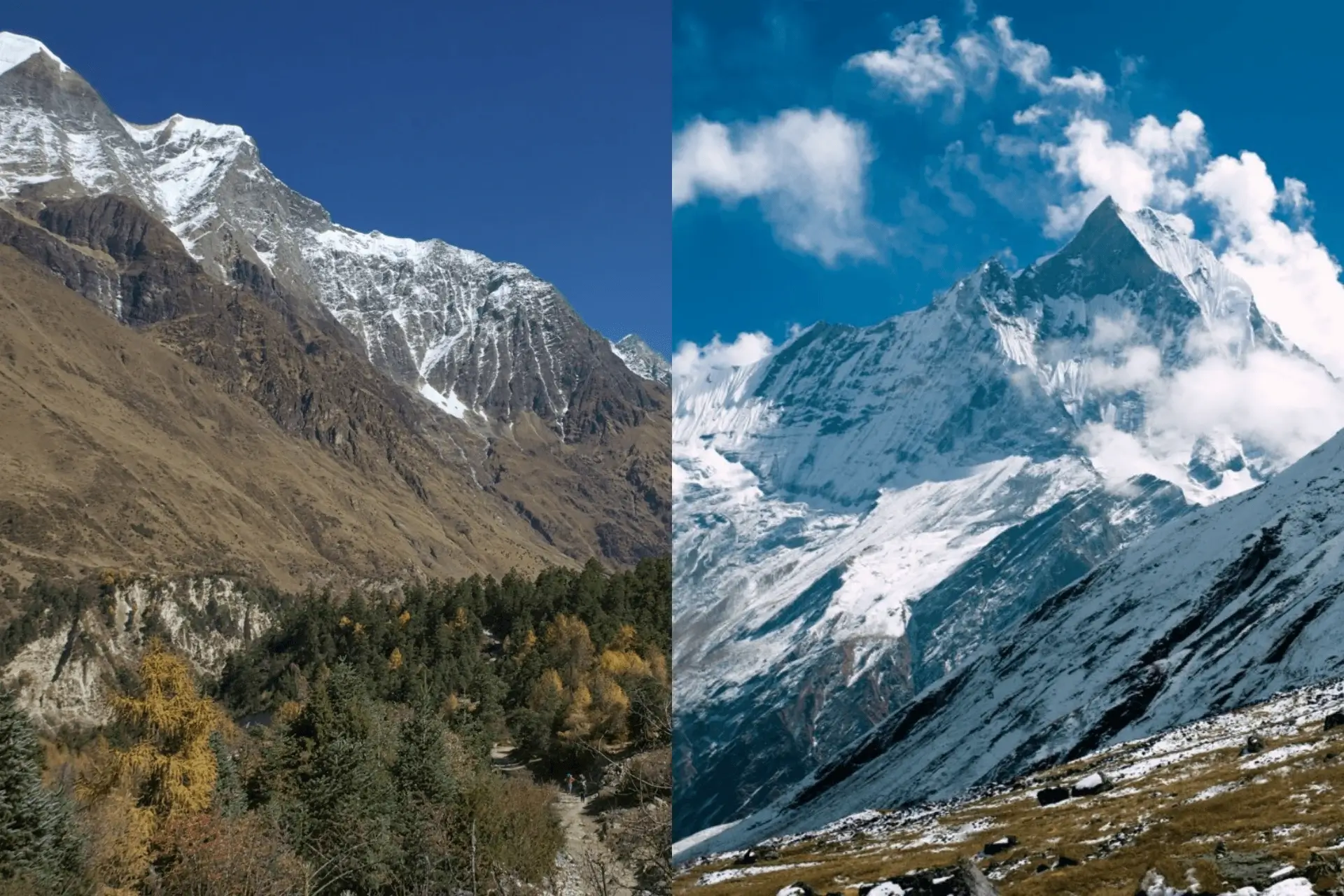
Every year, thousands of trekkers land in Kathmandu with one question already half-answered in their heads: Annapurna Circuit, right? It is the classic. The photos are everywhere. The forums say it is manageable. The teahouses are good.
All of that is true. The Annapurna Circuit is one of the great long-distance treks on earth, and it has earned every word of praise it receives.
But here is what the forums mention less often: the Manaslu Circuit, the route that circles Nepal’s eighth-highest mountain through a restricted wilderness area that most trekkers walk past on their way to somewhere more famous, is arguably the more extraordinary experience. Less visited, more demanding, and in 2026, still genuinely raw in the best possible sense.
Quick Summary: Manaslu Circuit vs Annapurna Circuit Trek
- Annapurna Circuit is ideal for first-time high-altitude trekkers, offering varied landscapes, comfortable teahouses, and easier logistics.
- Manaslu Circuit delivers a quieter, more remote trekking experience with rich Tibetan Buddhist culture and fewer crowds.
- Annapurna requires ACAP and TIMS permits, while Manaslu also needs a Restricted Area Permit and a licensed guide.
- Thorong La Pass (5,416m) on Annapurna is slightly higher than Larkya La Pass (5,160m) on Manaslu, but Manaslu is generally more physically demanding.
- Both treks are best completed during spring (March–May) or autumn (October–November) for clear weather and stable trail conditions.
- Choose Annapurna for accessibility, diverse scenery, and classic Himalayan trekking.
- Choose Manaslu for solitude, authentic cultural immersion, and a more adventurous off-the-beaten-path experience.
An Overview of the Two Regions: Manaslu Circuit vs Annapurna Circuit Trek
1. The Annapurna Region
The Annapurna massif sits in central Nepal and contains some of the most visited trekking terrain on the planet. At its centre is Annapurna I (8,091m), the tenth highest mountain in the world. The region spans dramatic variation in landscape and climate, from the subtropical lower valleys around Pokhara to the high-altitude desert plateau of the Mustang rain shadow in the north.
The Annapurna Circuit is the centrepiece, but the region supports a wide range of trekking options across varying fitness levels and timeframes.
GST treks in the Annapurna Region:
- Annapurna Circuit Trek, 16 Days — the full classic route via Thorong La Pass (5,416m)
- Annapurna Circuit Trek, 11 Days — a faster pace for trekkers with limited time
- Annapurna Circuit with Tilicho Lake, 13 Days — adds one of the world’s highest lakes to the circuit
- Annapurna Sanctuary Trek, 11 Days — into the glacial amphitheatre surrounded by 7,000m+ peaks
- Nar Phu Valley Trek, 15 Days — a restricted area extension into one of Nepal’s most isolated valleys
- Kali Gandaki Trek, 11 Days — following the world’s deepest gorge between Annapurna and Dhaulagiri
- Annapurna Gurung Trail Trek, 8 Days — a cultural route through Gurung villages with panoramic ridge walking
- Annapurna Balcony Trek, 7 Days — a shorter option with high-altitude views
- Annapurna Ridge Trails Trek, 6 Days — accessible and scenic for first-time trekkers
2. The Manaslu and Tsum Region
Manaslu (8,163m) is Nepal’s eighth-highest mountain and sits in the Gorkha district northeast of Pokhara. The Manaslu Circuit is a restricted-area trek, requiring a special permit and a registered guide, and circles the mountain through deep river gorges, ancient Tibetan Buddhist villages, and the Larkya La Pass at 5,160m.
The Tsum Valley, accessible as an extension from the main circuit, is one of the most sacred and isolated Buddhist pilgrimage routes in the Himalayas, closed to outsiders until 2008.
GST treks in the Manaslu and Tsum Region:
- Manaslu Circuit Trek, 14 Days — the full circuit via Larkya La Pass
- Manaslu Circuit Tsum Valley Trek, 19 Days — combines the circuit with the sacred Tsum Valley
- Tsum Valley Trek, 10 Days — for those focused on the cultural and Buddhist pilgrimage route
- Tsum Valley and Ganesh Himal Base Camp Trek, 11 Days — adds the Ganesh Himal base camp to the Tsum route.
The Head-to-Head Comparison
1. Scenery and Landscape
Annapurna Circuit: The variation is the headline. The circuit descends through terraced rice fields and rhododendron forests, climbs to the barren high-altitude plateau around Manang, crosses the Thorong La, and drops into the deep Kali Gandaki gorge on the other side.
The change in landscape every few days keeps the visual experience fresh throughout. The Annapurna Sanctuary variant trades that variety for something more concentrated: a glacial bowl ringed by peaks over 7,000 metres, including Annapurna I, Machapuchare (the sacred Fishtail Peak), and Hiunchuli.
Manaslu Circuit: Less variety, more intensity. The route follows the Budhi Gandaki river gorge through increasingly dramatic terrain, with Manaslu dominating the skyline in ways that feel personal rather than distant. The high point, Larkya La Pass (5,160m), offers one of the finest mountain panoramas in Nepal, including views of Himlung, Cheo, Kang Guru, and Annapurna II. The Tsum Valley extension adds ancient cliff-carved monasteries and sky cave systems to an already remarkable itinerary.
Verdict for French trekkers: Those who want variety and a walk-through-every-climate-zone experience will prefer the Annapurna Circuit. Those who want immersion in a single, increasingly dramatic mountain environment will prefer Manaslu.
2. Crowd Levels and Trail Character
Annapurna Circuit: One of the most trekked routes in Asia. In spring (March to May) and autumn (September to November), the trail is busy, particularly at higher-altitude sections and teahouse hubs like Manang and Muktinath. The trail infrastructure is excellent and the teahouses are comfortable, which is either a feature or a drawback depending on what you came for.
Manaslu Circuit: Significantly quieter. The restricted area permit requirement keeps numbers low. The teahouses are less polished, but the hospitality is more personal. On many sections of the circuit, you will walk for hours without meeting another trekking party. For French trekkers used to routes like the Tour du Mont Blanc, where solitude requires a 5 am start, this is a genuine departure.
Verdict: If quiet trails and a sense of genuine remoteness matter to you, Manaslu wins without much competition.
3. Cultural Experience
Annapurna Circuit: The Gurung and Thakali communities along the route are among the most culturally distinct in Nepal. Gurung villages retain traditional architecture, festivals, and in older generations, memories of Gurkha military service across two centuries.
The Thakali people of the upper Kali Gandaki have historically been the great trading families of the region, and their hospitality culture is reflected in the quality of teahouses in towns like Marpha and Kagbeni. The circuit passes through Muktinath, one of the most sacred sites in both Hinduism and Buddhism, visited by pilgrims from across South Asia.
Manaslu Circuit: The villages along the Manaslu Circuit and Tsum Valley belong to Tibetan Buddhist communities that maintained their culture through centuries of relative isolation. The monasteries are ancient and active.
The prayer flags, mani walls, and chortens are not decorative: they are working parts of daily religious life. Tsum Valley in particular has been described by anthropologists as one of the best-preserved examples of pre-modern Tibetan Buddhist culture anywhere in the Himalayas. You will see this if you take the time to stop, and the guides who know these communities will make those stops meaningful.
Verdict: Both are exceptional. Annapurna offers more accessible cultural interaction across a wider range of communities. Manaslu offers a deeper immersion in Tibetan Buddhist culture for those willing to go further.
4. Permits and Logistics
Annapurna Circuit: Requires the Annapurna Conservation Area Permit (ACAP) and a TIMS (Trekkers’ Information Management System) card. Straightforward to arrange. Does not require a mandatory guide, though the route benefits significantly from one.
Manaslu Circuit: Requires a Restricted Area Permit (approximately USD 100 per week), a Manaslu Conservation Area Permit, and a TIMS card. The restricted permit must be obtained through a registered trekking agency and requires a minimum group of two trekkers with a licensed guide. You cannot do this route independently.
For French trekkers accustomed to planning, this is simply an item on the pre-departure checklist rather than a serious obstacle. GST handles all permit logistics as part of the package.
5. Physical Demand
Annapurna Circuit (full, 16 days): The Thorong La Pass at 5,416m is the high point and the defining physical challenge. Proper acclimatisation over the days approaching Manang makes this achievable for fit trekkers without prior high-altitude experience. Daily walking stages average 5 to 7 hours.
Manaslu Circuit (14 days): The Larkya La Pass at 5,160m is slightly lower than Thorong La but the approach is more demanding in terms of cumulative elevation gain and trail conditions. The route is less forgiving on infrastructure: river crossings, narrow gorge paths, and sections without fixed teahouses require more self-sufficiency and better physical preparation. Recommended for trekkers with at least some prior experience above 4,000m.
Verdict: Annapurna is more accessible for first-time high-altitude trekkers. Manaslu rewards prior experience.
6. Season and Weather
Both routes share the same optimal seasons: spring (March to May) and autumn (October to November). The Manaslu Circuit sits partially in a rain shadow, making it viable slightly earlier in spring and slightly later in autumn than purely southern routes. The Annapurna Circuit’s northern sections around Manang and Mustang are among Nepal’s driest trekking zones.
Neither route is recommended during monsoon season (June to September) for the main circuit, though the Tsum Valley receives less rainfall than the southern Annapurna approaches.
What French Trekkers Specifically Should Know
The French trekking market in Nepal is strong and getting more sophisticated. The days of picking a route based on what was in the Lonely Planet are long past. French trekkers increasingly research in depth, ask specific questions about trail quality and cultural experience, and want guides who can offer context rather than just navigation.
A few points worth highlighting for French travellers specifically:
- Both routes connect strongly to the French mountaineering tradition. Annapurna I was the first 8,000-metre peak to be summited in history, reached by Maurice Herzog and Louis Lachenal in 1950. Walking through the Annapurna region carries that history in a way that is genuinely moving if you know it.
- Acclimatisation is non-negotiable. Both routes require proper staging. The itineraries GST provides are designed with real acclimatisation days rather than rushed timelines. Do not book a 7-day version of a route that needs 14.
- The food is better than you might expect. Dal bhat is the staple, and it is genuinely good. The Thakali kitchens along the Annapurna Circuit are famous across Nepal. Manaslu teahouses are more basic, but the hospitality compensates.
The Honest Summary
Choose the Annapurna Circuit if you want variety, accessible trail infrastructure, strong cultural interaction across multiple communities, and a route that rewards a range of fitness levels. It is a classic for good reason, and the 16-day itinerary remains one of the finest long-distance walks on earth.
Choose the Manaslu Circuit if you want solitude, more demanding terrain, deeper immersion in Tibetan Buddhist culture, and the feeling of walking a route that has not yet been worn smooth by mass tourism. The Tsum Valley extension adds something genuinely rare: a living pilgrimage culture that most trekkers in Nepal never see.
Both routes are best walked with a guide who actually knows the mountains, the communities, and the conditions. That is not a brochure line. In restricted areas, especially, the difference between a knowledgeable guide and a basic one is the difference between a cultural experience and a walk between teahouses.
Trek with a Guide Who Knows the Mountain
Glacier Safari Treks is a Kathmandu-based trekking company with deep experience across both the Annapurna and Manaslu regions.
Our team will give you an honest answer about which route suits your fitness, your timeframe, and what you want from the experience.
Explore all treks or contact the team directly at gstreksnepal.com/contact/
FAQs
Which trek is harder: Manaslu Circuit or Annapurna Circuit?
Manaslu is the more demanding of the two. While the Larkya La Pass (5,160m) is slightly lower than the Annapurna Circuit’s Thorong La (5,416m), the Manaslu route has less forgiving trail infrastructure, more remote sections, and a more physically cumulative approach.
Can I do the Manaslu Circuit without a guide?
No. The Manaslu Circuit is a Restricted Area, which means a government-registered guide and a minimum group of two trekkers are legal requirements, not optional extras. The restricted area permit must be arranged through a licensed trekking agency.
Which trek is better for experiencing Tibetan Buddhist culture?
Manaslu and the Tsum Valley extension offer a deeper immersion in Tibetan Buddhist culture. The communities along the Manaslu Circuit and Tsum Valley have maintained pre-modern Tibetan Buddhist traditions through centuries of relative isolation, and the monasteries, mani walls, and pilgrimage routes are active rather than preserved for tourism.
What is the best time of year for each trek?
Both treks share the same optimal windows: spring (March to May) and autumn (October to November). Spring offers rhododendron forests in bloom at lower altitudes and stable pre-monsoon conditions at altitude. Autumn follows the monsoon with clear skies and excellent mountain visibility. The Manaslu region’s partial rain shadow makes it viable slightly earlier in spring and later in autumn. The Annapurna Circuit’s northern sections around Manang are dry year-round, making the full circuit feasible in more marginal months for fit and experienced trekkers.
How long does each trek take, and can either be shortened?
The Annapurna Circuit takes 11 to 16 days, depending on pace and route variation. The 11-day version is feasible for fit trekkers but removes buffer days for acclimatisation and weather. The 16-day itinerary is the version that allows the route to be experienced properly. The Manaslu Circuit takes 14 days for the main circuit, with the Tsum Valley extension adding 5 to 6 days.