

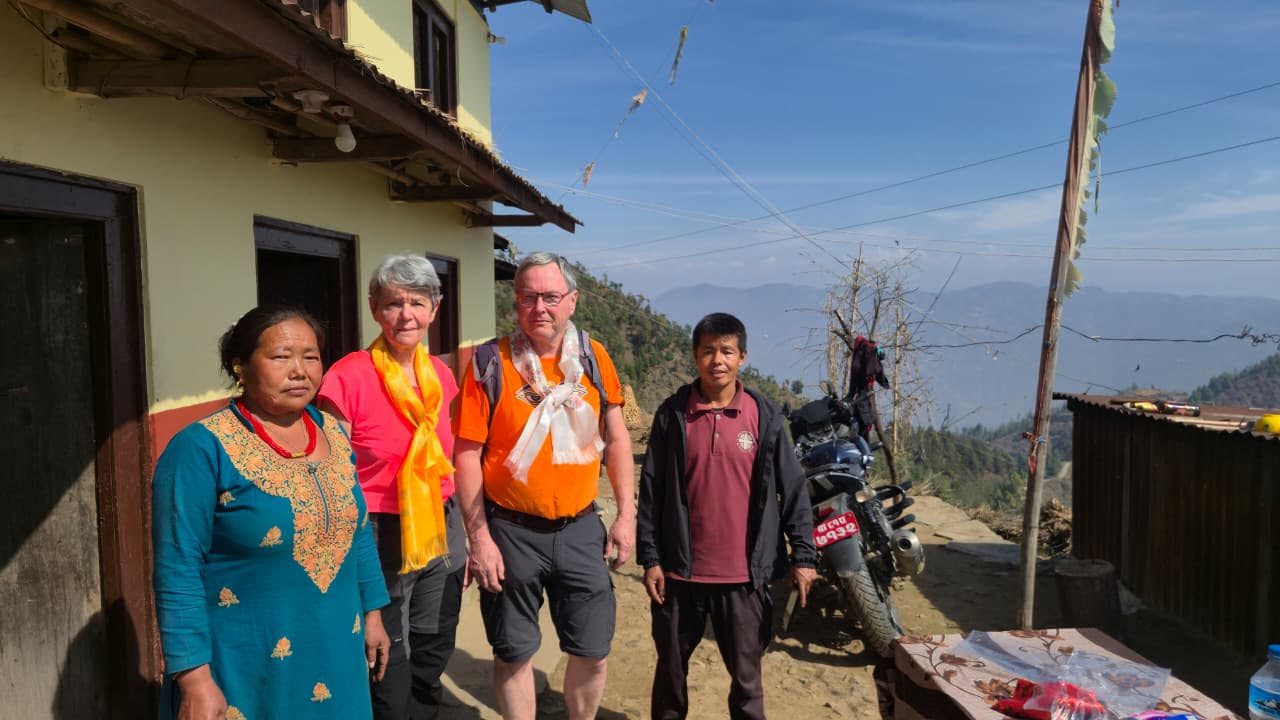
Laurence and Philippe have just returned from a three-day stay in Magar and Tamang villages east of the Kathmandu Valley. They share their impressions:
These few days spent in a Nepalese region far from the usual tourist routes went perfectly and matched exactly the kind of experience we had hoped for.
We travelled by jeep along the eastern highway, which, after Dhulikhel, descends toward the Terai plains. It is also the same road that leads to the Solu region, south of Everest.
After four hours on the road, we walked for about two hours to reach the village of Khanigaon, where we were welcomed by Kancha’s family. The village clings to the hillside and is surrounded by beautiful expanses of terraced fields. Prayer flags flutter in front of every house. There are no trekking trails here, and during these three days, we did not encounter any other tourists. Together with Kancha’s wife, we helped prepare the family meal.
The following morning, after a hearty breakfast, we set off along a steep trail toward Magarsalu. From the ridgelines, the view gradually opened up to reveal the snow-covered peaks of the Himalayas. We passed the region’s secondary school and then followed a beautiful contour trail before arriving in the village of Magarsalu. Some of the houses in this Tamang and Magar village are clustered together along a ridge, while others are scattered across the hillsides, carved into terraces. Here too, colourful prayer flags can be seen in front of every home.
We received a very warm welcome from Gyan’s family. The small room reserved for guests was simple but clean. The shower consisted of a small cemented room where a bucket of hot water was provided upon request. It was basic, but already a luxury compared with what exists in neighbouring villages. The toilet facilities were also located outside.
Following the 2015 earthquake, the Franco-Nepalese association Samdo Avenir rebuilt beautiful Tamang-style houses together with local residents and later launched a community-based tourism project managed by the villagers themselves. This support included assistance with guest room improvements, shower facilities, water supply infrastructure, and other essential works. For more information, visit the association’s website.
After sharing lunch with the family, we set off to explore the village with our guide, who is himself a resident of the community. We were able to visit the municipal office, then the nearby health post, where we met the nursing staff. At the small primary school in Kerabari, we attended a prize-giving ceremony. Back at the family home, Gyan’s mother taught us how to make momos, the Tibetan-origin dumplings that are so popular throughout Nepal.
Early the next morning, we observed the daily milk collection. Every morning, a small truck arrives, or mules are used when the road is blocked, carrying storage tanks and equipment used to test the quality of the buffalo milk brought by villagers in metal containers. Milk production provides an important source of income for local families.
Every household owns at least one buffalo, along with a few goats and some chickens. The goats are generally sold before the Dashain festival in autumn.
After breakfast, we climbed to the village of Katarche, where we were once again welcomed by a Tamang family. We toured the village and visited the local cheese dairy. The owner provided fascinating explanations about the production process and the history of the enterprise.
We then returned to the road to meet our jeep and continued on to a wonderful stay at the resort in Namobuddha, located close to the famous Namobuddha Monastery. According to Buddhist tradition, this is the sacred site where the Buddha offered his own body to feed a starving tigress. From the resort terrace, we enjoyed sweeping panoramic views of the Himalayan range.
These few days felt like travelling back in time and rediscovering a rural Nepal where life still follows the rhythm of the harvests and Buddhist festivals.
We would strongly recommend spending two or three days in these villages either before or after a trek. It is easy to combine such a stay with a trek in the Solu region, for example. These days can also be paired with visits to the Kathmandu Valley.
A heartfelt thank you to our guide and to the families who welcomed us into their homes.